Soil Monitoring
Soil Moisture
Soil moisture is a critical variable in both ecological and hydrological systems. It influences plant growth, microbial activity, nutrient cycling, and the rate of carbon sequestration. At the Lamont Sanctuary Forest, researchers are monitoring soil moisture levels as a way to understand both the ecological functioning of the forest and the physical drivers of soil carbon change. Because moisture varies significantly by elevation, slope, and season, it is a highly spatially and temporally dynamic property.
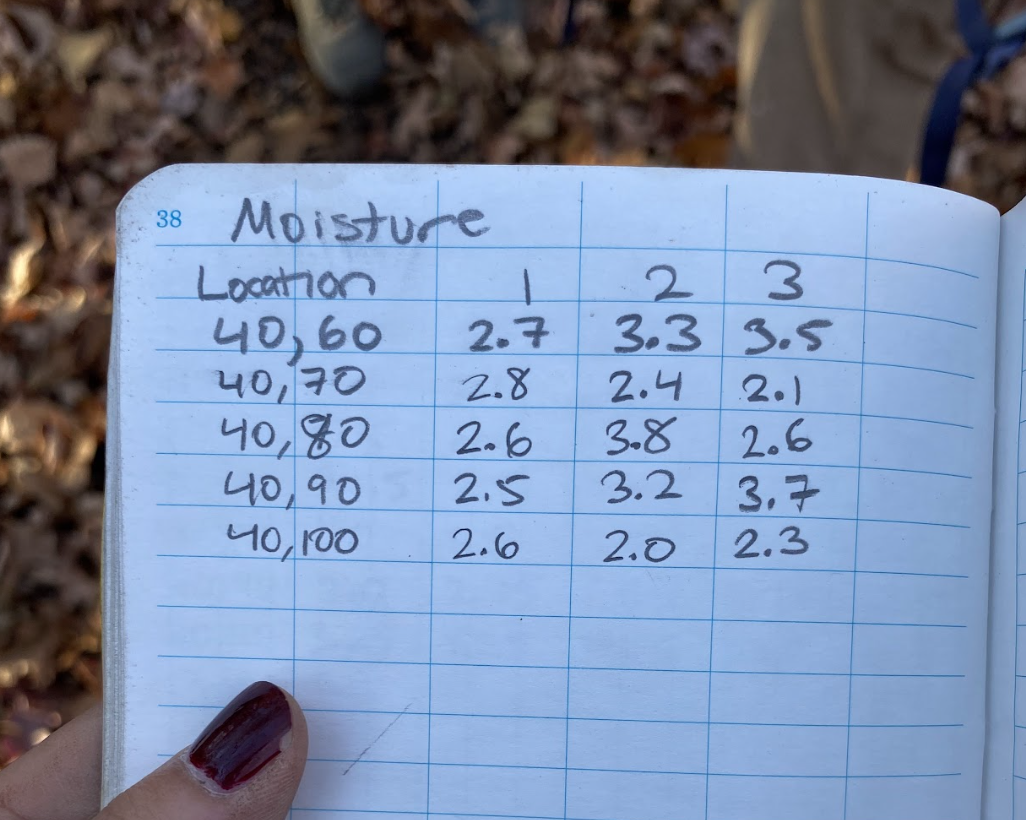
Figure 1: A student researcher's notebook after taking moisture readings around the LSF.
In the 2024 campaign, Lamont researchers used handheld sensors and digital probes to collect soil moisture data at multiple depths and across dozens of sampling points. These measurements are supplemented by topographic wetness index (TWI) values calculated from digital elevation models (DEM), offering a proxy for potential moisture accumulation zones. Together, these datasets help map moisture variability across the forest and predict its influence on both tree growth and soil respiration.
Moisture is also a key covariate in many of the machine learning models used to estimate soil carbon and greenhouse gas (GHG) fluxes. In dry zones, carbon decomposition slows down, potentially increasing long-term storage. In wetter zones, microbial activity may increase CO₂ or CH₄ emissions. Understanding these dynamics is essential to modeling ecosystem responses under climate change, and for designing land use practices that optimize carbon storage.
Soil Health Indicators
Dynamic Soil Properties (DSPs) are soil characteristics that change over short timescales and are sensitive to factors like vegetation, climate, and land use. In 2024, the Lamont team adopted the NRCS DSP4SH framework to evaluate soil health through measurable indicators. These included permanganate oxidizable carbon (POXC), bulk density, soil respiration, water-stable aggregates (WSA), and enzyme activity—each offering a window into the functioning and resilience of the soil system.

Figure 2: An instance of soil carbon testing.
These indicators were collected using field kits and lab-based methods aligned with national protocols. POXC measures the readily available pool of organic carbon that supports microbial life, while WSA reflects the soil’s structure and resistance to erosion. Bulk density relates to compaction and root penetration, and soil respiration indicates microbial activity and nutrient cycling. All together, these variables offer a multi-dimensional view of how "healthy" the soil is—and how likely it is to store carbon and support forest regeneration.